



Act early. Surfactant helps developing lungs stay open1–5
As soon as signs indicate non-invasive support isn’t enough, administer CUROSURF to support lung protective care.1–6
From escalation to earlier intervention
Lung maturity and surfactant production develops along a spectrum rather than completing at a fixed gestational age, meaning clinical progression is not always predictable.1–5
Some infants stabilise on CPAP. Whilst others deteriorate despite similar starting points. This variability places greater emphasis on recognising the early signs of worsening RDS and acting before escalation becomes necessary. CPAP failure, when it occurs, is associated with substantially poorer outcomes than CPAP success.6
Guidelines and emerging evidence support earlier intervention — guided by objective thresholds and delivered with appropriate technique and dose — to anticipate deterioration rather than respond to established failure.7–12
Variability makes timing critical
Gestational age alone doesn’t define risk
While lower gestational age is associated with higher RDS risk at a population level, at an individual level, the picture is more variable.1
Lung development is an ongoing process, and surfactant synthesis and function can vary considerably from one infant to the next.2–5
Two infants at the same gestation, weight, and antenatal history can follow different respiratory trajectories — some may stabilise on CPAP, whilst others deteriorate unexpectedly.6,13–17
This variability can make identifying the optimal timing for intervention more challenging.
≤2 hrs — Earlier intervention may support better outcomes
Surfactant within the first 2 hours of life is associated with:18,19
- Lower mortality
- Reduced mechanical ventilation
- Fewer complications compared with delayed treatment
What the guidelines recommend
The 2025 European Consensus Guidelines recommend considering surfactant when:12
- FiO₂ >0.30 on CPAP ≥6 cm H₂O
- Lung ultrasound suggesting surfactant need
The goal is to anticipate CPAP failure — not react to it.12
Explore why variability exists
When CPAP doesn’t go to plan
A proportion of preterm infants initially managed on CPAP will go on to require intubation in the first days of life.6,12,14,20
When CPAP failure occurs, it is associated with higher rates of adverse outcomes, including:6
- Death — 22.2% vs 1.1%
- Bronchopulmonary dysplasia — 55.9% vs 43.4%
- Air-leak syndrome — 13.9% vs 0.7%
- Intraventricular haemorrhage — 47.2% vs 26.7%
- Patent ductus arteriosus — 42.6% vs 23.8%

The clinical picture beneath the numbers
When a surfactant-deficient lung is ventilated without adequate support, repeated alveolar collapse and over-distension can accelerate injury and drive inflammation.21,22 This helps to explain why timing matters in surfactant administration.2–4,21,22
The 2025 European Consensus Guidelines support surfactant treatment during non-invasive respiratory support in infants with worsening RDS, rather than waiting for established failure.12

Recognising when to act
Clear signals can support timely intervention.
When clinical trajectories can change quickly, recognising early signs of deterioration is key to supporting timely intervention. Validated markers can help reduce variability in decision-making and provide a more consistent approach to escalation. 2–5
FiO2 ≥0.30 — a practical clinical indicator
FiO2 is:23,24
- Routinely monitored
- Readily available in clinical practice
- A well-validated predictor of CPAP failure
European Consensus Guidelines recommend considering surfactant when:
- FiO2 ≥0.30 on CPAP ≥6 cm H2O
- Or lung ultrasound suggests surfactant need
These indicators can help identify worsening RDS earlier —
before escalation becomes unavoidable.
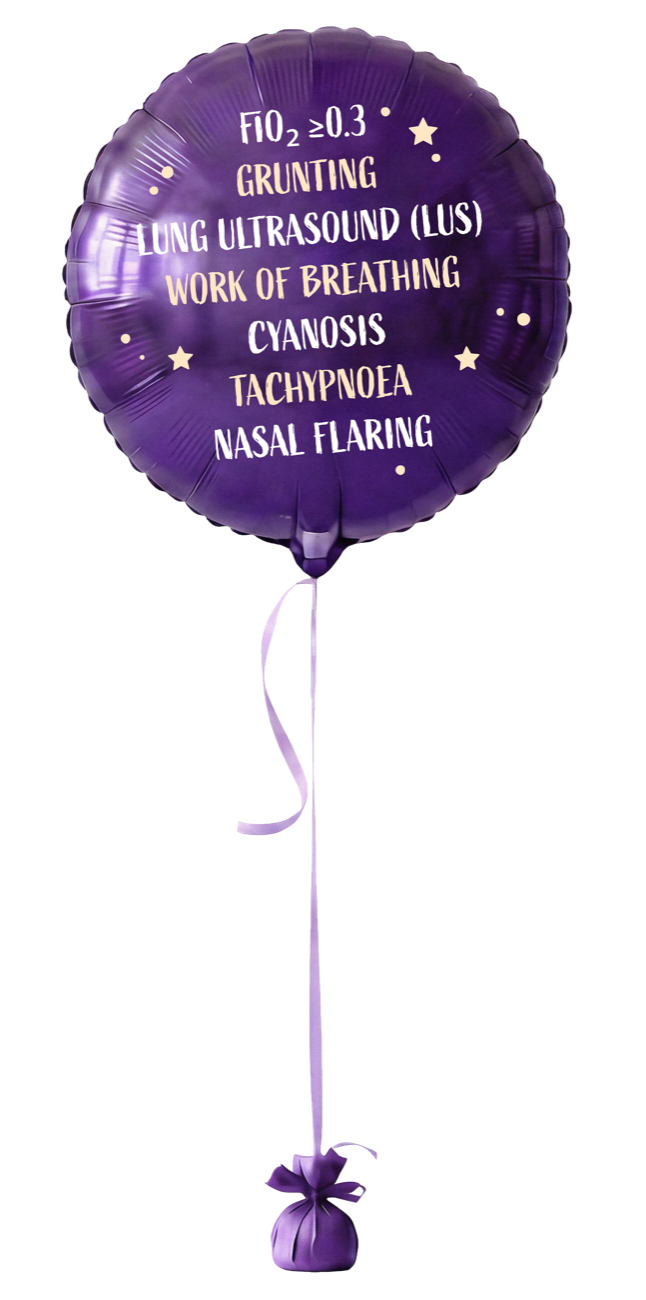
Lung ultrasound: an earlier signal where available25–27
Lung ultrasound (LUS) can complement FiO2 thresholds and identify surfactant need from 1 hour after birth, compared with around 6 hours using FiO2-based criteria alone.27
When embedded in early respiratory pathways, it can potentially shorten the time a surfactant-deficient lung spends unsupported.
- Validated across very preterm, late preterm, and term infants25
- Supports targeted use — minimising overtreatment without compromising outcomes26
- European Consensus Guideline-endorsed as a standalone trigger, regardless of FiO212
Recognise the signs to support earlier, consistent intervention
Delivering Early Rescue effectively
How surfactant is delivered matters too
The benefits of timely surfactant are fully realised when it reaches the lung with minimal disruption. Method and dose are part of the intervention.7–11

In spontaneously breathing infants on CPAP7–12:
- Less invasive surfactant administration (LISA) is recommended where expertise is available
- Alternative approaches (e.g. INSURE) remain appropriate where LISA is not feasible
The aim is consistent: deliver surfactant early while minimising exposure to invasive ventilation.
Compared with INSURE (intubate, surfactant, extubate), LISA is associated with reduced need for mechanical ventilation, lower mortality, and reduced bronchopulmonary dysplasia, without increased adverse events. Where LISA isn’t feasible, INSURE with rapid extubation remains a lung-protective alternative.7–12
The 2025 European Consensus Guidelines recommend thin-catheter (LISA) administration as the preferred route of surfactant delivery in spontaneously breathing preterm infants.12
Getting the initial dose right
The 2025 European Consensus Guidelines recommend an initial dose of 200 mg/kg of CUROSURF (poractant alfa), citing reduced need for repeat dosing, improved oxygenation, and reduced need for invasive ventilation compared with lower doses or other preparations.12

CUROSURF is designed to support timely, flexible intervention in preterm RDS:28
· Licensed across all gestational ages and infant weights
· Can be administered via LISA, INSURE, or conventional endotracheal routes
By supporting earlier timing, flexible administration, and guideline-recommended dosing, CUROSURF aligns with the principles set out across this pathway.14,28
Act early. Surfactant helps developing lungs stay open1–5
In preterm RDS:1–6
- Clinical progression is variable
- Deterioration may occur despite initial stability
- Opportunities for earlier intervention exist
Using objective clinical indicators to guide timely surfactant use may support:23–27
- Earlier identification of worsening RDS
- More consistent intervention decisions
- A shift toward lung-protective care
Abbreviations:
CPAP, continuous positive airway pressure; FiO2, fraction of inspired oxygen; INSURE, intubate, surfactant, extubate; LISA, less invasive surfactant administration; LUS, lung ultrasound; RDS, respiratory distress syndrome.
References
- BD Kamath, et al. Neonatal mortality from respiratory distress syndrome–Lessons for low-resource countries Pediatrics 2011;127(6):1139–1146.
- Bancalari E. In: The Newborn Lung. 2nd Ed. Netherlands, NL: Elsevier Saunders; 2012
- Rehman S and Bacha D. Embryology, Pulmonary. [Updated 2023 Aug 14]. In: StatPearls [Internet]. Treasure Island (FL): StatPearls Publishing; 2024 Jan-. Available at https://www.ncbi.nlm.nih.gov/books/NBK544372. Accessed May 2026.
- Han S and Mallampalli RK. The Role of Surfactant in Lung Disease and Host Defense against Pulmonary Infections. Ann Am Thorac Soc 2015;12(5):765–774.
- Cau F, et al. Interindividual Variability in the Expression of Surfactant Protein A and B in the Human Lung During Development Eur J Histochem. 2016;60(3):2678.
- Gulczynska E, et al. Fraction of inspired oxygen as a predictor of CPAP failure in preterm infants with respiratory distress syndrome: a prospective multicenter study. Neonatology 2019;116(2):171–178.
- Kwok TC, et al. Respiratory management and outcomes in high-risk preterm infants with development of a population outcomes dashboard. Thorax 2023;78:1215–1222.
- Subramaniam P, et al. Prophylactic or very early initiation of continuous positive airway pressure (CPAP) for preterm infants. Cochrane Database of Systematic Reviews 2021;10:CD001243. DOI: 10.1002/14651858.CD001243.pub4.
- Abdel-Latif ME, et al. Surfactant therapy via thin catheter in preterm infants with or at risk of respiratory distress syndrome. Cochrane Database of Systematic Reviews 2021;5. DOI: 10.1002/14651858.CD011672.pub2.
- Bao WKJ, et al. Effectiveness and safety profile of introducing less invasive surfactant administration in management of respiratory distress syndrome: A retrospective cohort study in a tertiary neonatal unit in Hong Kong. Pediatr Neonatol. 2024;6:S1875-9572(24)00116-5. doi: 10.1016/j.pedneo.2023.12.013. Epub ahead of print. PMID: 38991861.
- Silveira RC, et al. Less invasive surfactant administration versus intubation-surfactant-extubation in the treatment of neonatal respiratory distress syndrome: a systematic review and meta-analyses. J Pediatr (Rio J). 2024;100(1):8–24.
- Sweet DG, et al. European Consensus Guidelines on the Management of Respiratory Distress Syndrome: 2025 Update. Neonatology 2026:1–40.
- Yadav S, et al. Neonatal Respiratory Distress Syndrome. [Updated 2023 Jul 25]. In: StatPearls [Internet]. Treasure Island (FL): StatPearls Publishing; 2024 Jan-. Available at https://www.ncbi.nlm.nih.gov/books/NBK560779/. Accessed May 2026.
- Li Y, et al. Maternal diabetes mellitus and risk of neonatal respiratory distress syndrome: a meta-analysis. Acta Diabetol. 2019;56(7):729–740.
- Dargaville PA, et al. Continuous positive airway pressure failure in preterm infants: incidence, predictors and consequences. Neonatology. 2013;104(1):8–14.
- Dargaville PA, et al. Two-year outcomes after minimally invasive surfactant therapy in preterm infants. JAMA. 2023;330(11):1054–1063.
- Wright CJ, et al. Preventing Continuous Positive Airway Pressure Failure: Evidence-Based and Physiologically Sound Practices from Delivery Room to the Neonatal Intensive Care Unit. Clin Perinatol. 2018;45(2):257–271.
- Phuljhele S, Kumar Rathia S, K Chukkanakal J. Comparison of survival outcome in early versus late surfactant therapy in preterm neonates with respiratory distress syndrome at a tertiary care centre: A randomized control trial (Open). Int J Med Res Rev. 2017;5(7):754–756.
- Jayachandra Naidu T, et al. Study of the Outcome of Early and Late Rescue Surfactant Administration in Preterm Babies. Asian J Health Sci. 2014;2(2).
- Fuchs H, et al. Predictors of early nasal CPAP failure and effects of various intubation criteria on the rate of mechanical ventilation in preterm infants of <29 weeks gestational age. Arch Dis Child Fetal Neonatal Ed. 2011;96(5):F343–F347.
- Ainsworth SB. Pathophysiology of neonatal respiratory distress syndrome: implications for early treatment strategies. Treat Respir Med. 2005;4(6):423–437.
- de Prost N, et al. Effects of surfactant depletion on regional pulmonary metabolic activity during mechanical ventilation. J Appl Physiol. 2011;111(5):1249–1258.
- Raimondi F, et al. Inspired oxygen fraction thresholds to accurately predict surfactant administration in neonatal RDS in gestational age strata: A pragmatic, multi-center study. Pediatr Pulmonol. 2024;59:1638–1644.
- Kakkilaya V, et al. Early predictors of continuous positive airway pressure failure in preterm neonates. J Perinatol. 2019;39(8):1081–1088.
- De Luca D, et al. Quantitative Lung Ultrasonography to Guide Surfactant Therapy in Neonates Born Late Preterm and Later. JAMA Netw Open. 2024;7(5):e2413446.
- Zhang J, et al. Prospective, Non-Blinded, Randomized Controlled Trial of Pulmonary Surfactant Administration Guided by Lung Ultrasound in Preterm Infants with Gestational Age <32 Weeks. Children (Basel). 2025;12(12):1618.
- Rodriguez-Fanjul J, et al. Early surfactant replacement guided by lung ultrasound in preterm newborns with RDS: the ULTRASURF randomised controlled trial. Eur J Pediatr. 2020;179(12):1913–1920.
- Curosurf SmPC. Available at https://www.medicines.org.uk/emc/product/6450/smpc. Accessed May 2026.
